

Protective gloves against thermal risks (Heat and/or flame)
The EN407 Standard is made up of 6 distinct tests. Under this standard you will find two separate pictograms with clear differences between flame resistance (flame icon – protection against heat and flames) and non-flame resistance (wavy lines icon – protection against heat without flame). Each glove can only represent one of the pictograms, not both.
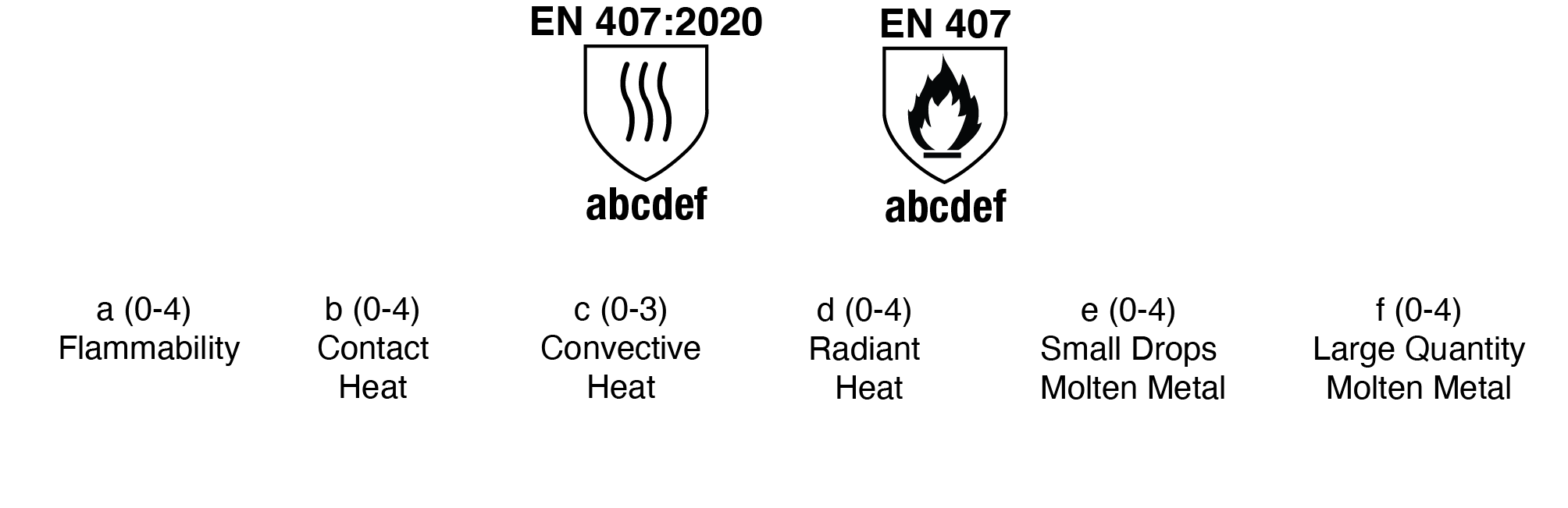
Resistance to flammability (Limited flame spread)
The glove’s material is stretched and lit with a gas flame. The flame is held against the material for 15 seconds. After the gas flame is distinguished, the length of time is measured for how long the material either glows or burns. The after-flame and after-glow time is measured in this test. The standard doesn’t permit the innermost surface of the test sample to show any sign of melting, complete holing of the sample or to come apart at the seams. Gloves that pass this test will hold the limited flame pictogram, not the wavy lines pictogram.
PERFORMANCE LEVEL AFTER-FLAME TIME (s) AFTER GLOW-TIME (s)
Level 1 – ≤ 15 seconds (after flame) no requirement (after glow)
Level 2 – ≤ 1o seconds (after flame) ≤ 120 seconds (after glow)
Level 3 – ≤ 3 seconds (after flame) ≤ 25 seconds (after glow)
Level 4 – ≤ 2 seconds (after flame) ≤ 5 seconds (after glow)
Resistance to contact heat
The glove’s material is exposed to temperatures between +100°C and +500°C. The length of time is then measured for how long it takes the material on the inside of the glove to increase by 10°C from the starting temperature (approx. 25°C). 15 seconds is the minimum accepted length of time for approval. For example: to be marked with class 2, the glove’s inside material must manage 250°C heat for 15 seconds before the material exceeds 35o°C. Gloves that pass this test will show the wavy line pictogram (protection against heat)
PERFORMANCE LEVEL CONTACT TEMPERATURE (°C) THRESHOLD TIME (s)
Level 1 – 100°C ≥ 15 seconds
Level 2 – 250°C ≥ 15 seconds
Level 3 – 350°C ≥ 15 seconds
Level 4 – 500°C ≥ 15 seconds
Resistance to convective heat
The amount of time is measured for the heat from a gas flame (80Kw/kvm) to increase the temperature of the glove’s inside material by 24°C.
Resistance to radiant heat
The glove’s material is stretched in front of a heat source with an effect of 20-40 kw/kvm. The average time is measured for heat penetration of 2.5 kw/kvm.
Resistance to small splashes of molten metal
The test is based on the total number of drops of molten metal required to increase the temperature by 40°C between the inside of the glove and the skin.
Resistance to large splashes of molten metal
Simulated skin is attached to the inside of the glove material. Molten metal is then poured over the glove material. The total number of grams is measured of how much molten metal is required to damage the simulated skin.
Click the button below to find all our EN407 compliant gloves.
Sign up for our newsletter!
Stay up to date with the latest Watson Gloves news, releases, and industry updates by signing up to our newsletter!

 Loading ...