
CORPORATE SOCIAL RESPONSIBILITY
ENVIRONMENT
Environment
Watson Gloves is dedicated to protecting hands and our planet throughout every facet of our organization. In order to do this we utilize the 7 stages of sustainability framework: 1) Corporate 2) Premise 3) Design 4) Plant, Materials and Processes 5) Supply Chain 6) Logistics 7) End of Life
7 Stages of Sustainability

Corporate

Premises

Design

Plant, Materials & Processes

Supply Chain Management

Logistics

End of Life
Sustainability Highlights
The 7 stages start at the corporate level and for Watson Gloves that change started 6 years ago where we determined our just cause, set sustainable goals and joined the Green Business Benchmark to hold ourselves accountable.
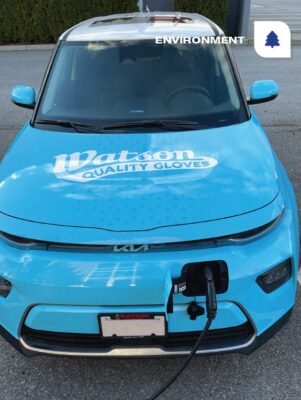
Next, (stage 2) we needed to consider our facilities, we established a comprehensive recycling program, updated to LED lighting and even installed EV chargers in our head office.
Stage 3 – Design wise – we get creative with glove construction. Do we use recycled materials, biodegradable additives, renewable materials or focus on durability? Sometimes we do all 4.
Outside these Watson walls we collaborate with manufactures to reduce co2 emissions and use eco-friendly packaging like tags made from recycled paper and cardboard j-hooks.
Stage 5 and 6 – have us optimizing supply chain management and logistics. We cut waste by consolidating containers, standardizing outer carton sizes and managing warehouse space efficiently.
In our final stage – we consider end of life – we look at what happens to our gloves and excess material when we are done with them. We also have a line of gloves using our landfill biodegradable additive called Reclaim™. In our Green Monkey line, our gloves degrade in landfill conditions in only 10 years as opposed to other nitrile disposables that take up to 200+ years.
Packaging
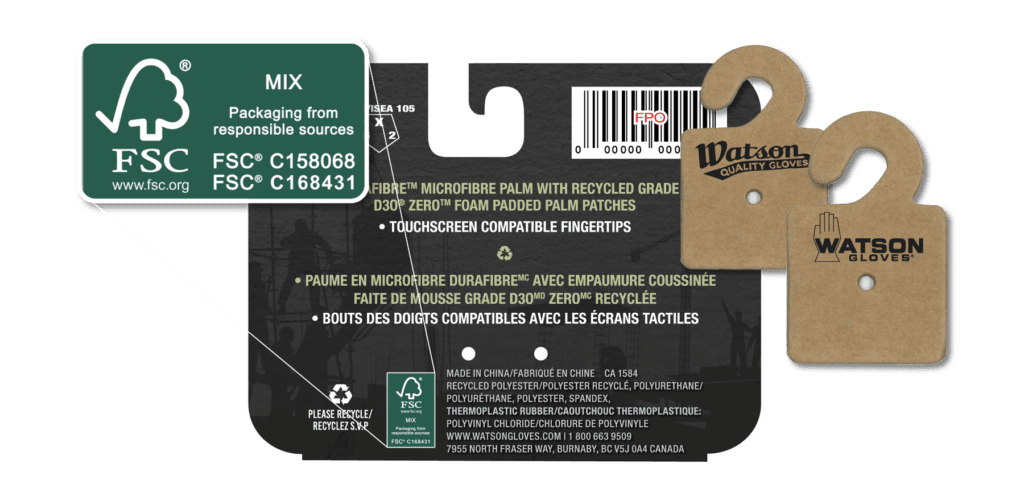
Not only do we use recycled materials in our gloves, we also use them in our packaging too! 95% of our tags now use FSC recycled cardboard as well as kraft paper j-hooks and come in biodegradable polybags.
FSC – stands for Forest Stewardship Council which refers to paper that is certified responsibly sourced; so it’s not logged from old growth forests but under sustainable logging practices. It also looks after safeguarding of ancient and endangered forests and ensures forestry workers are getting a fair wage with a good work environment.
There are 3 types of labels you’ll see – 100% FSC, recycled or mixed FSC.
Mixed – is a mix of FSC recycled paper and FSC virgin paper. Watson Gloves is using a mix between Mix and recycled FSC.
You’ll also notice a certificate number on each FSC logo on our tags – unique to each of our printers that our suppliers use will have its own number which will be displayed on the tags to be easily traceable. We will hold our printers accountable to ensure their license is up to date and getting their paper from accreditable sources.
This logo is on thousands of other companies packaging that consumers are aware of and understand.
Recycling Bins at Watson
We’re proud to introduce recycling stations at all of our branches, providing our staff with easy and convenient ways to reduce waste and minimize our environmental footprint.
Our recycling stations are designed to accommodate various types of waste, including food scraps, paper, and containers. By separating these items at the source, we’re able to divert a significant amount of waste from landfills and promote responsible waste management practices.
From leftover lunch containers to paper waste from meetings, our staff can simply drop their recyclables into the appropriate bins, knowing that they’re contributing to a more sustainable future. We believe that every small action adds up to make a big difference, and our recycling stations empower our team to be part of the solution.
Recycled Material
We are committed to reducing our footprint at all three of our branch locations. Changes range from big and small, and we’re especially proud of our efforts to reduce leather scraps, plastic shrink wrap, food scraps and plastic strapping. See below the ways we’re making our business more sustainable:
Commercially Composted Items
55,924 lbs
Diverted from Landfills
(July ‘18 – April ‘26)

Leather Scraps Recycled
109,256 lbs
(July ‘18 – April ‘26)

Plastic Shrink Wrap Recycled
35,159 lbs
(July ‘18 – April ‘26)

Plastic Strapping Recycled
20,187 lbs
(July ‘18 – April ‘26)

EV Charging Stations
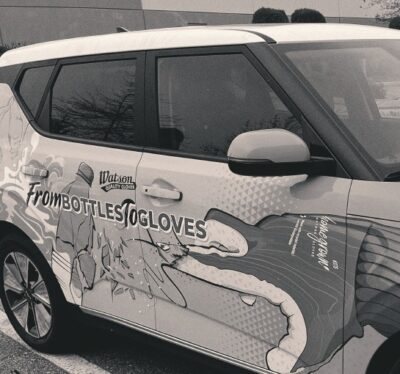
You may even get to see our new EV car driving around the Vancouver area showing off our bottles to gloves marketing! At our head office in Burnaby we have 7 EV charging stations.
Other Changes
- Coffee mugs – reusable for branch office use
- Coffee-to-go mugs – offered to staff
- Reusable water bottles for all staff
- Cutlery – no plastic – now compostable wood
- Stir sticks – no plastic – now compostable wood
- Coffee pods – moved all 3 branches to Muldoon’s 100% Omnigradable, which means the packaging will break down in any environment where microbes are present, even landfills.
- No more plastic cups – we now only use cups made from 100% renewable resources certified by BPI and meet ASTM standards for compostability
- Transitioned to LED lighting in all of our 3 branches – 30% energy savings
- Transitioned to 50% post consumer printer paper
- Catalogues – available online to reduce the number we need to print
- Set up a recycling program for all pens, felt pens, sharpies
- Polybags – We use landfill biodegradable polybags

 Loading ...