


How to Choose the Right Chemical Resistant Glove
In many industrial environments, chemical exposure is not a matter of if, but when. From oil & gas, mining, manufacturing, maintenance, laboratories, and chemical handling, workers’ hands are often the first point of contact with hazardous substances. Selecting the right chemical‑resistant glove is critical. Not only for worker safety, but also for regulatory compliance and long‑term operational reliability.
This is where EN374‑1 plays a vital role. As the primary standard for chemical protective gloves, EN374‑1 establishes clear performance requirements for a glove’s resistance to permeation by hazardous chemicals. Rather than relying on general claims of “chemical resistance,” EN374-1 provides measurable, standardized testing that helps safety professionals and workers compare gloves and their level of chemical resistance for certain chemicals.
Understanding EN374‑1 enables organizations to move beyond guesswork and make informed PPE decisions. The standard classifies gloves by their level of chemical protection, identifies which chemicals have been tested, and defines how long a glove can resist chemical permeation before breakthrough occurs. When applied correctly, it helps ensure that the glove selected is fit for the task, the chemical, and the duration of exposure.
In this article, we’ll break down what EN374‑1 covers, how chemical resistance is evaluated, and why choosing gloves that meet this standard is essential for protecting workers’ hands in chemically demanding environments.
Why Use Chemical Resistant Gloves?
- To protect hands from burns, rashes or allergic reactions caused by chemicals
- To reduce risk of long-term heath issues though prolonged exposure to chemicals over time
- Gloves are a part a comprehensive PPE which can include other equipment such as safety suits or respirators
- Some chemical gloves are used to protect against biological hazards such as bacteria and viruses

Understanding the Standard
EN374-1:2016 Resistance to Permeation
Resistance to permeation is assessed by measuring the time for a chemical to break through the glove material. Samples, cut from the palms of the gloves are placed in a permeation cell, which enables the chemical to be placed in contact with the outer surface of the glove. For gloves longer than 400mm, three test specimens from the cuff area will also be required. Collection air or water is passed through the cell to collect any chemical that has broken through to the inside surface of the glove samples.
The ‘chemical-resistant’ glove pictogram must be accompanied by at least a 3-digit code. This code refers to the code letters (A-T) of at least 3 chemicals (from a list of 18 standard chemicals as shown below), for which a breakthrough time of at least 30 minutes has been obtained.
| CODE LETTER | CHEMICAL | CAS NUMBER | CATEGORY |
|---|---|---|---|
| A | Methanol | 67-56-1 | Primary Alcohol |
| B | Acetone | 67-64-1 | Ketone |
| C | Acetonitrile | 75-05-8 | Nitrile Compound |
| D | Dichloromethane | 75-09-2 | Chlorinated Paraffin |
| E | Carbon Disulfide | 75-15-0 | Sulphur |
| F | Toluene | 108-88-3 | Aromatic Hydrocarbon |
| G | Diethylamine | 109-89-7 | Amine |
| H | Tetrahydrofuran | 109-99-9 | Heterocyclic & Ethereal |
| I | Ethyl Acetate | 141-78-6 | Ester |
| J | n-Heptane | 142-85-5 | Saturated Hydrocarbon |
| K | Sodium Hydroxide 40% | 1310-73-2 | Inorganic Base |
| L | Sulfuric Acid 96% | 7664-93-9 | Inorganic Mineral Acid |
| M | Nitric Acid 99% | 7697-37-2 | Inorganic Mineral Acid |
| N | Acetic Acid 99% | 64-19-7 | Organic Acid |
| O | Ammonium Hydroxide 25% | 1336-21-6 | Organic Base |
| P | Hydrogen Peroxide 30% | 772-84-1 | Peroxide |
| S | Hydrofluric Acid 40% | 7664-39-3 | Inorganic Mineral Acid |
| T | Formaldehyde 37% | 50-00-0 | Aldehyde |
Permeation: The process by which a chemical agent migrates through the protective glove at a molecular level (performance level 0 to 6). Performance levels are assessed according to the breakthrough times of the chemicals. Breakthrough is deemed to have occurred when the flow rate of 1ug/cm2/min is reached.
| BREAKTHROUGH TIME | PERFORMANCE LEVEL | BREAKTHROUGH TIME | PERFORMANCE LEVEL |
|---|---|---|---|
| > 10 Minutes | Level 1 | > 120 Minutes | Level 4 |
| > 30 Minutes | Level 2 | > 240 Minutes | Level 5 |
| > 60 Minutes | Level 3 | > 480 Minutes | Level 6 |
Pictograms
Gloves are separated into 3 classification types based on permeation performance – TYPE A, TYPE B or TYPE C. The standard used to use a beaker icon, however now there are three flask pictograms as shown below.

TYPE A: Protective glove with permeation resistance of at least 30 minutes each for at least 6 test chemicals

TYPE B: Protective glove with permeation resistance of at least 30 minutes each for at least 3 test chemicals

TYPE C: Protective glove with permeation resistance of at least 10 minutes each for at least 1 test chemicals
How Do You Pick A Glove Using The Standard?
There are some key questions you need to answer first before choosing a chemical-resistant glove:
- What chemical are you looking to protect against?
- What is the application where this chemical is present?
- What type of glove are you currently wearing to handle this chemical?
- Are there any other hazards to consider (ie. impact, cut, puncture, abrasion)?
- Ask or search for the MSDS/SDS sheet for the specific chemical you are handling.
Once you have the answers to these questions, you can use our Chemical Resistant Chart to find the right chemical-resistant glove.

Research the MSDS or SDS Sheet for the Chemical You Are Handling
An MSDS (Material Safety Data Sheet), now typically called an SDS (Safety Data Sheet), is a fact sheet for a chemical.
It will tell you everything you need to know about how to use, store and handle a chemical safely. The most important sections of an MSDS/SDS sheet are:
- Product Info – What chemical is and what its used for
- Hazards – what can go wrong
- Ingredients – what’s inside the product
- First Aid – What to do if exposed
- Fire Info – How to put out a chemical fire
- Spill Cleanup – How to clean a spill
- Handling and Storage – How to store it safely
- Personal Protection – What protective gear to wear

How to Use the Chemical Resistant Chart
The Chemical Resistance Chart helps you identify which gloves provide protection against specific chemicals. Begin by locating the chemical you are working with in the chart, then follow across the row to see which glove is recommended, limited, or not suitable for that substance. Each glove is evaluated using recognized EN 374 standards, allowing you to compare performance based on chemical exposure.
The chart also indicates breakthrough time, which shows how long it takes for a chemical to penetrate the glove material under laboratory testing conditions. Selecting a glove with a breakthrough time that exceeds your task duration helps ensure safer, more effective hand protection and supports proper PPE selection for the job. Please refer to the chemical MSDS sheet for more information.

Choose Your Gloves!
Now that you have learnt about how to determine what chemical(s) you are working with, and which types of gloves best defend against them, you are ready to select your glove! Below are some of our new and popular styles.
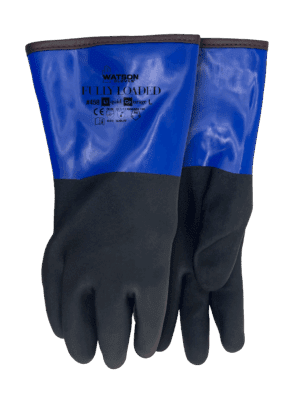
#458 Fully Loaded
- EN374-1:2016 Type A
- Meets ANSI/ISEA Cut Level A3
- Fully dipped PVC coating
- Provides chemical protection against sodium hydroxide 40% (>480 mins), sulfuric acid 96% (>480 mins), nitric acid 65% (>480 mins), acetic acid 99% (>120 mins), n-heptane (60 mins), formaldehyde 37% (>480 mins), and hydrogen peroxide 30% (>30 mins)
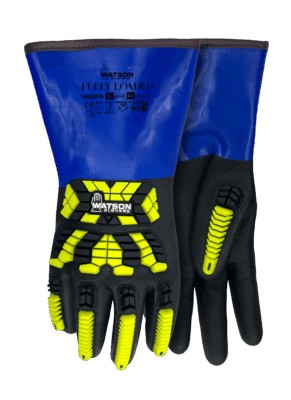
#458TPR Fully Loaded
- EN374-1:2016 Type A
- Meets ANSI/ISEA Cut Level A6
- Meets ANSI/ISEA Impact Level 2
- Provides chemical protection against sodium hydroxide 40% (>480 mins), sulfuric acid 96% (>480 mins), nitric acid 65% (>480 mins), acetic acid 99% (>120 mins), n-heptane (60 mins), formaldehyde 37% (>480 mins), and hydrogen peroxide 30% (>30 mins)
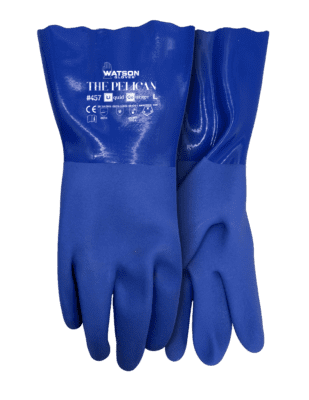
#457 The Pelican
- EN374-1:2016 Type A
- Triple dipped PVC coating
- Sandy finish
- Provides chemical protection against methanol (>60 mins), sodium hydroxide 40% (>480 mins), sulphuric acid 96% (>120 mins), nitric acid 65% (>240 mins), acetic acid 99% (>60 mins), ammonium hydroxide 25% (>30 mins), hydrogen peroxide 30% (>480 mins), and formaldehyde 37% (>480 mins)

#WG12 The Old Fashion
- EN374-1:2016 Type A
- 12″, 14″ & 18″ gauntlet available
- Sure-grip textured finish
- Provides chemical protection against n-heptane (>30 mins), sodium hydroxide 40% (>480 mins), sulphuric acid 96% (>240 mins), nitric acid 65% (>240 mins), hydrogen peroxide 30% (>480 mins), hydrofluoric acid 40% (>480 mins), and formaldehyde 37% (>480 mins)
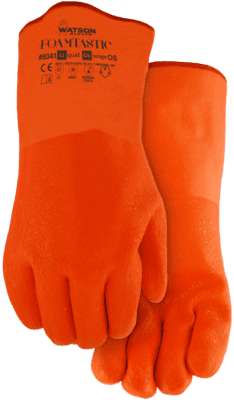
#9341 Foamtastic
- EN374-1:2016 Type A
- Warm foam lining
- Double dipped PVC coating
- Provides chemical protection against methanol (>60 mins), sodium hydroxide 40% (>480 mins), sulphuric acid 96% (>60 mins), nitric acid 65% (>60 mins), hydrogen peroxide 30% (>480 mins), hydrofluoric acid 40% (>240 mins), and formaldehyde 37% (>480 mins)
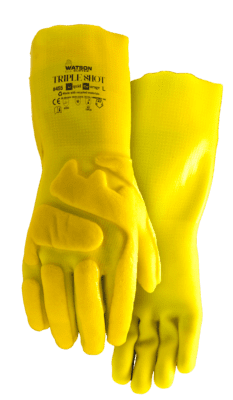
#455 Triple Shot
- EN374-1:2016 Type B
- Meets ANSI/ISEA Cut Level A3
- Hi-vis yellow
- Fully coated PVC with sandy finish
- Provides chemical protection against sodium hydroxide 40% (>480 mins), sulphuric acid 96% (>60 mins), and formaldehyde 37% (>480 mins)
Determine Size Needed
Fit matters! It is more than comfort—it’s about safety and efficiency.
Gloves should:
- Match hand size and shape.
- Allow natural movement without excess bulk.
We have gloves for all hand sizes. Poor fit can compromise safety and performance, so sizing is critical. Need help to determine your size? Use our sizing chart (charts for both men and women).
Choosing the right chemical-resistant glove involves balancing protection, dexterity, grip, wear areas and durability. By following these steps, you ensure your team and work site is equipped with gloves that not only meet safety standards, but also enhance performance and comfort.
Have more questions? Reach out to our Hand Protection Specialists for more information.
Additional Materials

Chemical Resistant Product Program
WARNING AND DISCLAIMER
Watson Gloves hereby warns all potential users of its chemical-resistant products that they are not suitable for all uses.
These products have been tested in lab conditions only.
Nothing in the material accompanying this warning or in any other statement made by or on behalf of Watson Gloves should be construed as a warranty of the merchantability of any chemical resistant Watson Gloves product or that any Watson Gloves product is fit for a particular purpose.
Watson Gloves disclaims any responsibility for the suitability or adequacy of its products for any specific use by and end user.
Sign up for our newsletter!
Stay up to date with the latest Watson Gloves news, releases, and industry updates by signing up to our newsletter!

 Loading ...