

CORPORATE SOCIAL RESPONSIBILITY
MARKETPLACE
Marketplace
We are constantly pushing the envelope in product innovation and sustainability to elevate the glove industry. Currently we have over 100 products that use sustainable materials and have diverted over 4 million post consumer plastic water bottles from landfills by using them in our gloves (rPet).
Our Suppliers
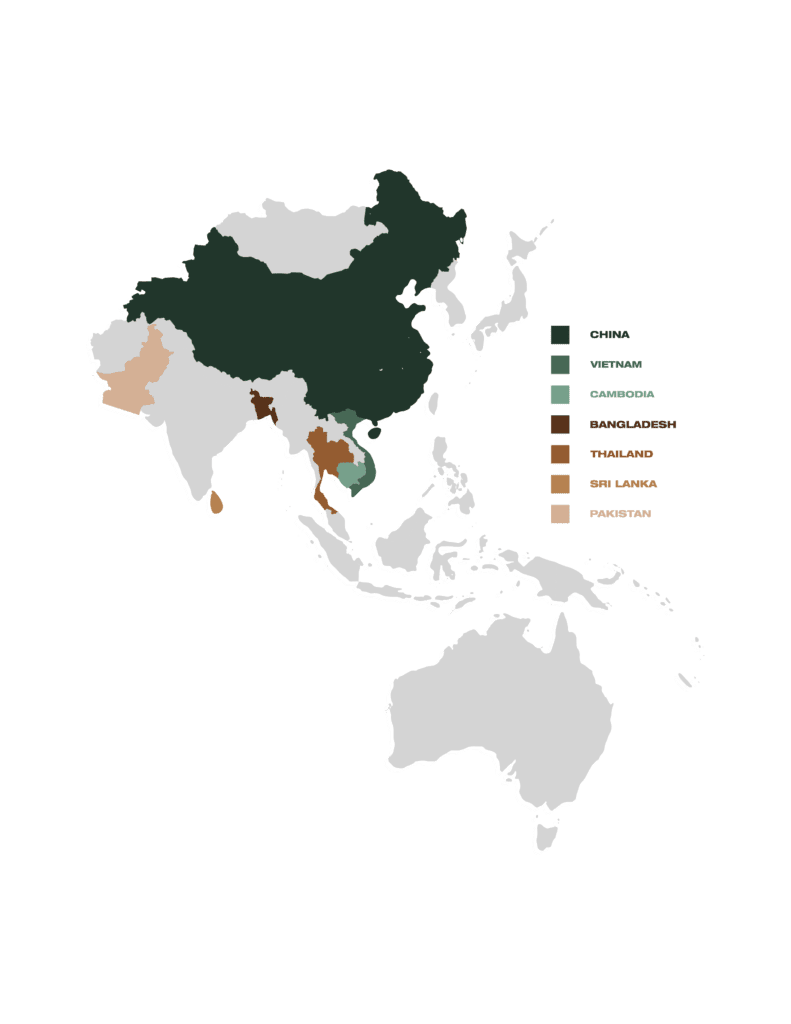
This map shows where our manufacturing supplier partners are located around the world. Any new supplier partners are vetted extensively before we conduct business together. We also inspire our suppliers to elevate when it comes to sustainable and environmental practices at their facilities and provide them with a vendor performance scorecard each year.
Code of Conduct
Watson Gloves demands a high standard of excellence in every aspect of our business; including external parties that are involved. In order to achieve this specific standard of excellence, Watson Gloves expects that we as a corporation, our suppliers, and every other party in our supply chain, complies with our code of conduct, by demonstrating a sufficient level of ethical standards and ethical actions in every operational area. We will employ third party auditors on an annual basis to ensure that our code of ethics is being followed accordingly in regards to legal and social compliance to ensure fair working conductions at all factories. Watson Gloves expects suppliers to be transparent about their operations for continued business. This is achieved by displaying respect for the rights of individuals, professional business conduct, and respect for the environment.
Our team also conducts yearly factory tours visits and meetings with our supplier partners to ensure compliance at all levels.
Our suppliers maintain a certification under an approved auditing program based on third-party certification of workplace conditions. Current approved programs for certification that are updated yearly include:
• Worldwide Responsible Accredited Production (WRAP)
• Social Accountability International SA8000 Standard
• Business Social Compliance Initiative (BSCI)
• Sedex Members Ethical Trade Audit (SMETA)
• Better Work
• Fair Labor Association (FLA)
Products We Manufacture
We’ve been making gloves in our local Canadian factory since 1918 and manufacturing gloves with our supplier partners overseas since the 1960’s. With over 2000 sku’s our focus is quality and partnering up with the right suppliers who see our vision to protect hands across North America.
Emissions Scopes
What are emissions scopes?
Every business has a carbon footprint associated with its normal operations. Corporate emissions are generally categorized into “scopes” to help bucket emissions sources and behaviors.

Scope 1 – direct emissions from company assets. Scope 1 includes emissions from combustion, process emissions and accidental emissions like leaks and spills.

Scope 2 – indirect emissions from purchased energy like heating and cooling buildings and running production processes.

Scope 3 – all other emissions associated with a company’s activities
Scope 3 typically represents the most significant contributor to a company’s carbon footprint and what Watson Gloves focuses on because it includes things like:
• Waste generated in operations and waste disposal
• Purchased goods and services
• Transportation and distribution tied to suppliers and customers
• Emissions from the use of a product or service sold
• Product’s end of life (when it’s no longer useful)
How can sustainable products help?
This is where sustainable products like sustainable PPE bring measurable value via globally accepted reporting metrics. We have a broad portfolio of hand protection solutions to meet your requirements for form, fit and function. In addition, we have developed tools to quantify the sustainability impact of our solutions. Let Watson Gloves show you how sustainable hand protection can help meet your ESG’s.
Sustainability Impact Calculations

Recycle
Used water bottles are used to produce WasteNot™ recycled PET (rPET) fiber.

Replace
PET used to produce gloves is replaced with WasteNot™ recycled PET (rPET) fiber.

Calculate
Watson Gloves calculates the total carbon saved by replacing virgin PET with WasteNot™ rPET, made from recycled water bottles, for each glove style.
Convert
Sustainability impact calculations are based on the total carbon saved over virgin PET for each glove style. Energy equivalents provided by EPA WARM.
Production
Analysis
Sustainable Calculator
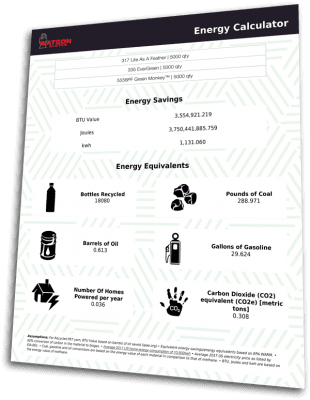
Watson Gloves knows how important it is for end users to be able to quantify their sustainable efforts towards their own ESG goals – and they can now do just that. We have created a ESG calculator using EPA Warm model where you can input your Watson’s glove style and quantities purchased and it will automatically output in seconds, how many bottles you’ve helped divert from landfills and CO2 reduction from using Watson’s sustainable gloves.
- Sustainability calculator provides incremental carbon savings provided by the consumption of specific styles of gloves.
- Carbon savings varies by style/type of glove based on materials of construction.
- Equivalent energy savings/energy equivalents based on EPA WARM
Ask your Hand Protection Specialist about how we can calculate your environmental savings.
Innovative Material
We’re always striving to be at the cutting-edge of glove innovation and that means being more conscious of our environment and making more sustainable products. Landfill biodegradable products and products that use recyclable materials are prime examples of eco-conscious products we’re proudly creating at Watson Gloves.
In 2020 we brought rPET to the industrial market with our launch of WasteNot™. Did you know that globally, humans buy a million plastic bottles per minute and 91% of all plastic is not recycled? On top of that, it is estimated that it takes up to 700 years for a plastic bottle to degrade. Now we have a solution to help with that waste by using recycled materials over virgin.
In 2023 we partnered up with 3M to be the first industrial manufacturer to bring recycled Thinsulate™ to the market and switched over the majority of our Winter styles to use this new innovation.
In 2025 we launched our first gloves using renewable materials to make biobased nylon. Did you know that by 2030, it’s predicted that the total US crop residue will be 320 million tons with 85% composed of corn husks and stalks? Explore the latest sustainable innovations we’re developing below:

Designed and sourced with environmental sustainability top of mind. WasteNot™ yarn is made from post-consumer recycled plastic bottles. The materials are certified by Global Recycled Standard and found in our new Homegrown™, Stealth™ and Work Armour™ brand.
Reclaim™ additive enhances product biodegradability in landfill conditions. Reclaim™ additive attracts microbes, which enables products to breakdown and biodegrade into biogas. The biogas is harnessed by modern smart landfills to create energy such as electricity. (ASTM D5511)

ReStalk™ biobased nylon is derived from corn husks and stalk waste, rather than being petroleum-based. Biobased fibres provide an alternative to petroleum derived products such as virgin nylon. Using biobased fibres reduces C02 emissions during production versus virgin nylon.

Recycled Thinsulate™ (Type EC) from 3M is made from 78% post consumer recycled plastic water bottles. 1-3 500mL plastic bottle is used in each pair of gloves. Watson Gloves is the first industrial glove manufacturer to use this innovation.
ZeroImpact™ is a foam material that provides protection and shock absorption. Not only does it protect workers hands but also protects the planet too by being a USDA certified biobased material. ZeroImpact™ foam is made from 40% biocarbon content derived from castor oil versus using petroleum based materials.
Standards for Testing
At Watson Gloves, we pride ourselves on being at the forefront of sustainable innovations in the glove industry. With a growing collection of sustainable products, we take environmental claims seriously and ensure to verify our claims with globally reputed standards and certifications.
Find below the standards and certifications we use for our sustainable products.
ASTM D5511 & D5526
ASTM D5526 and ASTM D5511 are the two most accepted and well-established standards for testing biodegradability in anaerobic environments (modern landfills). The performance of biodegradable products or materials is conducted in laboratories using standardized testing, which simulates landfill conditions.
RECYCLED CLAIM STANDARD & GLOBAL RECYCLED STANDARD
The Recycled Claim Standard & Global Recycled Standard establish requirements for certification of recycled content and chain of custody, and the Global Recycled Standard additionally establishes requirements for social and environmental practices and chemical restrictions.
Certified recycled materials in the entire supply chain must take the required measures to maintain the identity and integrity of the input material, from the raw materials to the final product. The textile must be made with a minimum percentage of certified recycled content depending on the standard.
OEKO-TEX® Standard 100
The OEKO-TEX® STANDARD 100 is a standard that tests for harmful substances in textiles. OEKO-TEX® accredited institutes conduct the tests in their labs based on OEKO-TEX®’s globally standardized criteria, which is updated at least once a year. In these tests, every single component of the textile is tested.
EN420
European standard that regulates PPE related to hand and arm protection. Specifically the EN420 certification governs the general requirements and test methods related to safety gloves.
This standard defines the general requirements valid for all protective gloves and sets requirements for glove marking.
• The glove itself shall not be a risk to wear or cause injuries to the user.
• The glove material shall have a pH value between 3,5 and 9,5.
• The Chrome VI level in the glove leather must stay at 2,9 mg/kg or below.
• If the glove contains any substances known to cause allergic reactions, it shall be stated in the product information.
• The glove sizes are standardized according to minimum length.
THE USDA BIOPREFFERED® PROGRAM & TESTING (ASTM D6866-18)
The U.S. Department of Agriculture (USDA) created the BioPreferred® Program as part of the 2002 Farm Bill to increase the purchase and use of biobased products. The program was reauthorized and expanded as part of the Agriculture Improvement Act of 2018 (2018 Farm Bill).
The Program’s purpose is to spur economic development, create new jobs and provide new markets for farm commodities. The increased development, purchase, and use of biobased products reduces our nation’s reliance on petroleum, increases the use of renewable agricultural resources, and contributes to reducing adverse environmental and health impacts.
ASTM D6866-18 is the standard test method to determine the biobased carbon/biogenic carbon content of solid, liquid, and/or gaseous samples using radiocarbon analysis.
REACH Compliance
REACH stands for Registration, Evaluation, Authorization, and Restriction of Chemicals. It’s a regulation set by the European Union (EU) that aims to protect human health and the environment from the risks associated with chemicals. REACH compliance for gloves means that the gloves adhere to the regulations outlined in the REACH legislation, ensuring that they are manufactured using safe chemical substances and that any chemicals used are properly registered and authorized. This compliance ensures that the gloves meet strict safety standards and do not pose harm to users or the environment.

3rd Party Audit System
We utilize QIMA – a third party audit provider that controls product and supplier quality with QIMA qualified inspectors and auditors to ensure our product meet specs, safety requirements, quality and to help improve supplier compliance.

Prop 65
Prop 65 is a California state law officially known as the Safe Drinking Water and Toxic Enforcement Act of 1986. This law aims to protect Californians from exposure to chemicals known to cause cancer, birth defects, or other reproductive harm.
For gloves, Prop 65 compliance means that the gloves meet the stringent requirements regarding the presence of any chemicals listed under Proposition 65. This includes chemicals such as lead, phosphates, and various other substances known to be harmful.
Manufacturers and distributors of gloves must ensure that our products sold to California must meet Prop 65 standards, ensuring that these chemicals are not present in the gloves and are tested through SGS laboratories.
USDA
Managed by the U.S. Department of Agriculture (USDA), the goal of the BioPreferred Program is to increase the purchase and use of biobased products. USDA’s goal is to make it easy for consumers to identify biobased products. The USDA Certified Biobased Product label provides useful information to consumers about the verified amount of renewable biological ingredients contained within a product and / or its packaging. Consumers can trust the USDA Certified Biobased Product label because the biobased content claims are third-party certified and monitored by USDA. There are currently more than 4,500 USDA Certified Biobased Products.

 Loading ...